Search This Blog

Tuesday, October 29, 2024

“The Guardian” by Michael D'Ambrosi (contemporary)

I was quite impressed with this bronze when I saw it listed in an auction online. The buy-it-now price was a bit high, so I watched it for about six months until I felt I had saved enough to make an offer that wasn't an insult. The buyer accepted my offer and in due course it arrived at my home. I was shocked by its size, it is quite large and heavy, and was impressed by the detailed polychromatic patina. I don't move it around that much.


Michael D'Ambrosi is a versatile sculptor. His subjects range across the board, from abstract to Western to animals to religious themes, and on and on. This is not so surprising though as he is the son of a sculptor, the much lauded late Jasper D'Ambrosi. Michael created this sculpture while he was in his "Apache phase," when virtually all of his output was of Apaches (and he made many). I have yet to contact him about this piece, but I am looking forward to it.


This bronze depicts a fit Apache man in traditional everyday dress circa 1870, a headband, wide white cloth loincloth held up by a thick gun belt complete with rifle shells around his waist, a pair of high buff hide boots and an all-over tan. His long black hair hangs loose across his chest and down his back. He is wearing what appears to be a shell, a polished stone or peace medal around his neck on a beaded necklace as well as another beaded necklace, likely turquoise or coral that hangs down past his navel. In his right hand he's casually carrying a rifle. He is standing on a pile of rocks or maybe a bluff, his pose relaxed but vigilant as he looks down at something below.


The bronze is mounted to a squared block of wood with a satin finish, nothing fancy. I may change it out for stone. Bases are typically added by the gallery and to the taste and budget of the buyer and are not specific to the artwork. Unless they were put there by the artists as part of the overall work (which usually shows), they're pretty much interchangeable and changeable, like frames on paintings.


Overall this statue is in immaculate condition and required not even cleaning when it arrived. The patinas are undamaged and nothing is dented, bent or broken. Even the wood base and brass tag are nearly pristine. It is signed by the artist, has the cactus sigil of the foundry and is numbered 4 of 24 on the bronze. It's a stunning bronze, no doubt about it. I'm glad I was able to bring it home.


I'll be taking new pictures soon, but until then, these will do.


Enjoy.


"The Guardian" by Michael D'Ambrosi, polychromatic bronze, 4/24, front


"The Guardian" by Michael D'Ambrosi, polychromatic bronze, 4/24, face


"The Guardian" by Michael D'Ambrosi, polychromatic bronze, 4/24, left


"The Guardian" by Michael D'Ambrosi, polychromatic bronze, 4/24, signature

“Indian Fisherman” by Earl Cary "Jack" Haines (May 11, 1927 - September 6, 1991)

 I know very little about this exquisitely sculpted bronze. I purchased it in an online auction from a charity thrift store which had received it as an anonymous donation. They were just as curious as I was about it and tried many of the same research avenues that I use, with sadly similar results. It took me awhile but I finally wrested from the web a scant bit of information about the artist and this I shared with the folks at the charity. They were as happy as I was to learn even as much as I did about it.


Earl Cary "Jack" Haines of Wichita, Kansas was a machinist, a tool and die maker specifically, for the Coleman Company (famed makers of camping equipment among many other things). It was said that only he could fix the machines used in the factory and so quickly that they hardly lost any time on the production lines. His hobby was woodcarving and he was a master. I stumbled across the website of a woodcarver who collects older carvings and he had one of Jack's pieces listed. The signatures matched and it was obvious to me that it was the same Jack Haines who sculpted my bronze. His obituary mentioned that a few of his carvings were cast in bronze, too. He had attended art shows and expositions where he displayed and sold his carvings, mostly throughout the southern Midwest of the US, from the 1970's until his passing in 1991.


This is a large bronze, easily commanding a significant amount of space on the average coffee table. The patina is polychromatic and in perfect condition, free of any visible damage or rubs. Depicted here is a muscular Indian man, likely in his late teens to early 40's, nude save for a brief and seemingly wet loincloth. His long black hair is parted in the middle and pulled back into two braids that hang over his shoulder and chest. He is standing on two rocks in a stream and is twisting down and to his left as he aims a bow held in his left hand with arrow at the ready at a leaping fish tail in the pooled water below. Rocks line the edge of the pool and dot the water in which he stands. The pose is very naturalistic, the colorful patinas masterfully applied. The bronze is signed by the artist but is not dated, nor is a foundry mark present. It is mounted on a finished wood base that was custom made to fit the unique footprint of the bronze. A brass plaque affixed to the base provides the title, artist's name and that is 1 of 15 that was to be made in the edition, though how many were actually cast remains a mystery. 


It is quite breathtaking and immediately captures the attention.


I'll update the pictures as soon as I take new ones.


Enjoy.


"Indian Fisherman" by Earl Cary "Jack" Haines, bronze, 1/15, front


"Indian Fisherman" by Earl Cary "Jack" Haines, bronze, 1/15, 1/4 turn left


"Indian Fisherman" by Earl Cary "Jack" Haines, bronze, 1/24, figure right


"Indian Fisherman" by Earl Cary "Jack" Haines, bronze, 1/24, left side


"Indian Fisherman" by Earl Cary "Jack" Haines, bronze, 1/24, signature


Monday, October 28, 2024

Indian Battle by E. Weldon (unknown dates)

 I purchased this small but highly detailed bronze on eBay along with one of my copies of Joe DeYong’s “Head of a Piegan.” There was no information accompanying this purchase. The seller had inherited the two bronzes along with a third (of a different subject that didn’t appeal to me) and knew nothing of them. This bronze clearly has some age and is far better made than even the best Asian knockoffs of other pieces that I’ve seen. After years of hitting a stone wall regarding my research into this piece, I’m posting it here.


I made up the title. All I know of this bronze is the name of the artist, or at least a last name and first initial. The work is signed "E. Weldon" on the front left of the base, rather prominently. There are no foundry, copyright or edition marks to be found anywhere on it. I have looked for even a mention of this bronze online and in books and have had zero luck finding another. This is actually not all that unusual when dealing with older, possibly antique artwork.  What has frustrated me the most however is that when I try searching the name, the plethora of streets in this country alone named "East Weldon" bring up real estate listings and addresses running to many pages. Add to that the many artists named "Weldon" (including the sculptor of the Iwo Jima monument, famed sculptor Felix De Weldon) and the obituaries of citizens named Weldon who earned bronze awards during their lifetimes that search engines end up churning out a morass of unhelpful information.


Depicted here is a muscular Native American Indian man who is seated on a leaping horse. He is holding a bow in his outstretched left hand, his right close to his right ear as if he’s just fired an arrow. His long, partially braided hair streams back in the wind. Across his bare chest is the thong of the quiver which rests along his back. He is wearing a loincloth, fringed leggings and moccasins. He is seated on a saddle blanket on the back of his leaping horse, the reins are missing but the bridle is present, a minor oversight. The horse touches the base only at the two rear hooves, quite a feat for the sculptor. Beneath the front hooves and chest of the horse is sprawled another Indian warrior. He is also bare chested, wearing only a loincloth and moccasins. He has what appears to be a Mohawk style haircut, a raised crest of hair from front to back and shaved on the sides, or perhaps he's wearing a hair roach. His left hand is extended upwards between the horse's front legs in an attempt to avoid being trampled. His right hand is gripping the shaft of an arrow which is buried in his solar plexus. This is causing him extreme pain, as witnessed by his thrown back head and mouth in a screaming rictus. His knees are raised as he digs his heels into the earth, whether merely curling in pain or as a precursor to rolling out from under the horse is debatable. The bronze is mounted on a veined block of black marble which shows signs of age and handling.


I’ve never seen anything quite like this bronze before. It is quite small, comparable in size to Carl Kauba's smaller works, sitting comfortably on the palm of my hand, but the level of detail is stunning. The action is violent, moreso than the vast majority of bronzes of Western subjects in my collection. One can almost hear the hoofbeats and the cries of the two Indians. The expressions on the faces of the warriors show both the heightened emotions and the intense pain of the tableau. Had this been made larger, it would be considered gory.


I find this sculpture fascinating. When doing research, I always seem to gravitate back to it, to try again to find some mention, any mention, of it, well, anywhere. Every time I try however I get zilch. Now I toss this one out to the public. Any and all help will be deeply appreciated!


Enjoy.


Indian Battle by E. Weldon, bronze, unknown date, front


Indian Battle by E. Weldon, bronze, unknown date, rear


Sunday, October 27, 2024

“Praying for Guidance - Sioux Warrior” by R. Jarvis Jones

I bought this knowing nothing of the artist or timeframe when this was created. After a fair amount of research, I’m still in the dark. All I know is what is written on the back of the bronze, the title, the artist's name and that it is number 1 of an expected edition of 24. Still in all, it’s a lovely piece.


Depicted here is a full-figure bronze of a young Sioux warrior. He is standing erect but barefoot and relaxed on a bluff, his hands down by his side, a tomahawk is gripped in his right hand. His face upturned to the sky, his long hair loose around his shoulders. His eyes are closed and his mouth is open, perhaps singing or chanting his prayer. The warrior is wearing nothing save a simple headband and a plain loincloth which is styled to look like buckskin, though it could be wrinkled cloth. A knife in a sheath hangs on his left hip. The entire sculpture is highly detailed and beautifully rendered. Overall it's a powerful image of an exercise in personal spirituality.


If someone out there knows more about this artist or sculpture, please let me know!


These temporary images are from the auction house that sold this bronze to me. I'll replace them as soon as I take new ones. Enjoy!


"Praying For Guidance - Sioux Warrior" by R. Jarvis Jones, bronze, 1/24, front


"Praying For Guidance - Sioux Warrior" by R. Jarvis Jones, bronze, 1/24, front from above


"Praying For Guidance - Sioux Warrior" by R. Jarvis Jones, bronze, 1/24, back


"Praying For Guidance - Sioux Warrior" by R. Jarvis Jones, bronze, 1/24, signature


Sunday, April 28, 2024

“Primitive Chant To The Great Spirit" by Hermon Atkins MacNeil - The Sculpture Unlocked

Hello again everyone! A series of life challenges has kept me from being very social for the last few years. Between recurring episodes of COVID, more spinal surgeries (two fusions - FINALLY) and a nasty cancer diagnosis in the family (I'm the caretaker), I haven't had the energy even to keep up my correspondences much less write blog posts. But today I feel a bit more energetic and I have a little free time between projects and appointments, so I thought I'd share my most recent discovery.


I have stated in the past that I believe in private ownership of art alongside public ownership of the same. Museum curators display art pieces as they see fit. The space, lighting, viewing angles, all and more are decided for the viewer as is the narrative that the curator wishes to advance. With private ownership, however, there is a greater freedom in all aspects of display. It is easier, in my opinion, to get a better all-around view of a work as well as to change the lighting and location and gain new, sometimes very surprising, insights from it.


This is definitely the case with my copy of Primitive Chant To The Great Spirit by Hermon Atkins MacNeil. As I mentioned in my previous post about this fine antique bronze, my copy was cast after the first finished version of the plaster model and was cast in a lot of three between 1910-1911. I believe they were given as gifts to Hermon MacNeil's family as the other two copies have his cousins at the beginning of their provenance. My copy does not have a complete chain of ownership, that having been broken in the 1990's when it was sold by an antiques dealer who did not provide any prior ownership records, but the characteristics of mine match exactly the other two MacNeil family copies cast during the aforementioned period.


Now, I had always admired this work, from the first time I saw a picture of one in a book of Western bronzes. I jumped at the chance to buy this casting. I've always thought the sculpting was exquisite, though I thought MacNeil's choices regarding Black Pipe's loincloth were a bit confusing. The front flap, while being animated, sits flat against the body instead of curling outward like the rear flap which is on the majority of the other copies (though not on the grouping of three from which mine comes, among a few other castings as well, one such being Geraldine Rockefeller Dodge's copy). It looks rather odd and not very representative of traditional Lakota menswear. But hey, what do I know? Black Pipe must have thought it was okay, so who am I to question?


I keep my Primitive Chant on the top of my antique oak roll-top desk, on the far right side, with my copy of The Sioux Brave Black Pipe plaque hanging on the wall behind and three copies of the Society Of Medalists medals that MacNeil also designed, each with a different patina and each on a stand. I had Primitive Chant positioned parallel to the wall so that Black Pipe faced off the right side of my desk. Well, this arrangement, while nice in the grouping, did little to open up the front of the sculpture to the rest of the room. A couple days ago, while dusting the room, I decided to turn Primitive Chant an eighth of a turn clockwise so that it faces the entry door. I found I liked that quite a bit, so I moved to the back of the room to grab my duster and finish the job.


When I turned around, I couldn't believe what I was seeing. I was floored. I gave my eyes a good hard rub and cleaned my glasses. That only made things clearer. It was breathtaking. I had to grab my phone and snap a picture. The image came out dark and a bit washed out, so in the viewer app I upped the exposure, washing out the image even more, so I had to dial up the contrast as well. The effect was compounded. I tried it again, changing the lighting and viewing angle. The effect disappeared and it went back to looking just like it always has. But with the lights thus, and the viewing angle such, MacNeil's true genius is on full display. The odd folds, bumps and flap resolve into perfect harmony. The trompe-l'oeil is amazing. The level of detail is much more in keeping with what I'd expect from a master sculptor like Hermon MacNeil in the prime of his life and at the height of his creativity. The way the front flap folds around now makes perfect sense.


I can hardly believe it, but it's there in the sculpture. I feel like I've discovered a long lost secret that was only known to a select few. This is how MacNeil intended informed viewers to appreciate this piece. I'm certain of it. For the rest of us, the "unwashed masses," perhaps this view was meant to be more a split-second subliminal expression designed to engage the viewer but not give away the game. What amazes me is that this sculpture was created in March of 1895. MacNeil managed to keep all that hidden in plain view for nearly 130 years. However I am reminded of the fact that MacNeil studied in Paris in his early 20's under a master sculptor and with some of the best young students of sculpture to be found. While I don't think this revelation will change history books, it may open some eyes to the possibilities inherent in other statues by other artists.


I strongly doubt any museum curator is going to display Primitive Chant in THIS manner!


With all that being said, here is my best photograph of Primitive Chant To The Great Spirit by the supremely talented Hermon Atkins MacNeil that fully captures the effect. As I stated, I had to bump the exposure, contrast and a touch of sharpness, but otherwise it's as taken. Please pardon the wall. I know I need to touch up the plaster and repaint the room. Like everything in my life, it's a work in progress. The picture is best viewed full size.


I think Black Pipe was quite the peacock!


Enjoy.


Primitive Chant To The Great Spirit by Hermon Atkins MacNeil, cast ca. 1910-1911, before


Primitive Chant To The Great Spirit by Hermon Atkins MacNeil, cast ca. 1910-1911, after


PS: If you happen to view another copy of Primitive Chant, one thing to consider is that the statue was not cast as one integral piece. The raised right leg was welded onto the upper thigh by Roman Bronze Works and may be a little bit off from casting to casting. Do not pay attention the position of the right leg on my casting when moving around another bronze and looking for Black Pipe's surprise.


PPS: Folks, the word of the month is the past tense transitive verb POLEAXED.  I still feel like Father Brennan, the priest who was also the Secret Satan(ist), in his final scene in the movie The Omen. Divine punishment as served up by the ghost of Vlad Țepeș. That was the day that I learned the etymology of the word “wow.” I was trying for a phrase beginning with “what” but could only stand there repeating “wha.” I still can't believe this is there, but I now know the secret and can see this whenever I start doubting my eyes and memory. It's real. Mac did it, Mac hid it, but I’ve seen it and now so have you.


PPPS: Here it is, a year and more on, and I find this is still a shock to my system. It makes me laugh. I have copies of the photographs of Black Pipe that Mac took in his Chicago studio. Several are likely from the sitting that produced Primitive Chant. They're in Mac's papers at the Smithsonian's National Archive of Art, conveniently on microfilm that is available for inter-library loan at your community library. They have faded quite a bit since 1894 but get lively with some contrast adjustments. Yep, this is Black Pipe. Startling but true to life. I appreciate Mac's honesty and restraint in putting it all out there while at the same time hiding it so well. Few sculptors I have found were both so talented and honest that they could manage this trompe l'oeil that masterfully. A nude is usually a nude and clothed is clothed. Primitive Chant manages quite adeptly to be both. Kudos, Hermon MacNeil!

Saturday, August 12, 2023

Indian Chief towel rack by the H. L. Judd Company, a cast iron antique

Not long ago, I was laying in bed recovering from yet another back surgery when I saw this pop up in an online auction. I had no idea what it was, but I knew that I needed to buy it. Spirited bidding ended with me winning the lot for not very much money. 


When it arrived in the mail, I realized that it had been repainted with a rattle can gold paint job which was used to cover large blobs of latex paint that gotten on it when someone painted the wall it was on. It looked terrible. However, the original paint was still on the back, so I thought I’d match that then strip off the horrid gold (I tried just removing the top coat but it had bonded to the original paint very well and all of it came off). I wound up very carefully scraping the paint off because the stripper had started removing the paint from the back.


I began my research into this intriguing cast iron towel rack. I managed to find one other that had been sold on eBay and the listing was archived on another website. The towel rail is called the Indian Chief model. There is a matching Indian Maiden version that was available as well. It had been made by the H. L. Judd Company around 1916-1920ish. Judd stopped producing their cast desk sets in the early 1920’s and was absorbed into another company in 1939, when all of their decorative castings were discontinued. I searched for quite some time, not only combing the H. L. Judd catalogues that have been scanned and are online but also purchasing an original copy from 1920 for my own reference bookshelf. I also scoured websites that keep records of past auctions as well as private sales. I came up with only the one, besides mine. Not many of these were made and they weren’t made for long. They’re considered to be very rare.


How it arrived, spray painted gold with latex blobs underneath.


The towel rack in the archived listing had the original paint on it, so I could see the scheme that they used. Honestly, I thought that the original paint washed out the figure and all the amazing fine details in the figure. If one looks closely at the raw metal sculpture, one can see that there is an incredible amount of very fine detail in the original sculpt, far more than I had expected to see in something made of cast iron. Judd didn’t put a lot of work into the paint job though so those details were lost in the wash of brown. Since other companies of the same period (Kronheim & Oldenbusch, for one) that made novelty castings (bookends, desk sets, souvenir statuettes and the like) offered their castings painted like carnival prizes, colorful and very detailed, I thought that the same treatment would be fitting for this piece.


The original paint scheme. Not very exciting.


Mostly stripped of the old paint.


Now, I’m not much of a painter, but I figured that I could do better than Judd did. So I went down to my local arts and crafts supply store and bought some enamel paint. I decided to try to match the original color that is extant on the back. It’s a sort of burnt sienna and I knew I’d have to mix it myself.


My selections. A limited but bright palette seemed in order.

I began by mixing the brown with a little orange. I nailed the original color on my first attempt! I used the fresh paint to infill some of the chipped areas on the back, to see how well I did. I now can’t tell where I painted! So I began to paint the front, starting with the skin.


First coat of skin tone. This is going to be awesome!


I went with a garnet red for the cape to make the figure pop a bit more. His braids are wrapped in red, a traditional color I’ve seen in old pictures of men from the Plains tribes. I was aiming for a dry grass color for his loincloth and worn buckskin for his moccasins. I did my best to pick out the details in the casting with color. After struggling with how to paint the background, I decided that a solid “14k gold” paint would be perfect, and after “antiquing” it with black I’m confident that I made the right choice. He looks to me like he’s about to step off the background.


The, umm, “special toning” at the bottom of his belly was a mistake that I left alone. I was toning his abdomen with black using a brush and rag. Some paint pooled in his bellybutton and spilled over when I tipped up the rack. I grabbed a dry brush in an attempt to pull out the black paint so I could wipe it off with the rag. The result was hilarious! I laughed so hard that I began to hiccup when I saw what had happened. As trying to remove that black paint or painting over it would likely have ruined the overall paint job, I decided to go the other way and add a little bit of black under his arms to complete the look. It IS anatomically correct, if not very PC. Well, it’s mine, I’ll change it when I feel like it. It’s just paint, after all.


After several days of working an hour or two on it, I finally got it to a point where I had to set it aside. Since the towel rack didn’t come with a method to attach it to a wall, I used Command Strips to stick it to the side of my period roll top desk. I’ll make a decorative bracket to hang it with, something that will match the background details.


Finished for now. I have yet to tone the feathers. That’s for later.


I am over the moon with how this turned out. I’ve amazed myself with this one, especially for my first attempt ever. I had such low expectations of my skills that I thought I’d be top coating with the factory paint wash. I'll be stripping this back to bare metal soon so I can treat the iron for a bit of surface rust, but for now I’m glad that I tried! 


Tuesday, October 27, 2020

“The Sioux Brave Blackpipe” by Hermon Atkins MacNeil (February 27, 1866 – October 2, 1947)

Once again, I have managed to score an impressive win in this plaque of Hermon Atkins MacNeil's studio assistant and oft-time model, Joseph Black Pipe (Lakota: Canunpa Sapa). After purchasing my casting of "A Primitive Chant To The Great Spirit" (see previous post), I found in myself a strong desire to own other works that H. A. MacNeil created of this young man. The story was just too fascinating, the art too fine to not throw my hat into the ring at the auctions. I bid on this plaque on three separate occasions over the course of two years. I missed the auction the first time it came up on the block in 2018, much to my wallet's chagrin, and failed to meet the seller's reserve in two others. In that time I also bid on the other known copy of this plaque, but the price ran swiftly to a very uncomfortably high place (with the buyer's premium especially) and I had to bow out. When I saw this plaque pop up for sale again, this time on the world's largest online auction site (yeah, one of my favorite hunting grounds), I had to try one more time. The starting bid was the same as the final bid that won the other plaque (the person who outbid me), but I knew that I would come out ahead with this one as I wouldn't have to pay a buyer's premium of around 28% (yikes). That meant I could afford to bid higher, though I was still sweating it. I was over the moon when I was not even bid up, much less outbid. 


The seller (an antiques dealer) had the plaque sent to me via an art and antiques expediter and it arrived home a mere two days after the shipper received it. Everyone involved, from the seller to the expediter to the fellows who drove the van over 470 miles to hand-deliver it to me, were all top-notch. I run out of superlatives, truly I do. If any of you happen to read this, thank you!!


This is one of at least five castings of this piece in bronze that is known by me to exist at this time (the original, believed to have been destroyed, was made of plaster). At least two of the bronzes had been cast by the legendary Roman Bronze Works in New York. The other (second to appear on the market so far) has a very even and intact ferric patina and has the Roman Bronze Works mark directly beneath the artist's signature as was more typical after Salvatore Schiavo purchased RBW in 1946. Mine has areas of antique wear to the patina, most notably to the chin and left cheek, which leads me to believe that it was frequently touched on those spots by many a hand. The patina in these areas has developed from that long familiarity and has a uniqueness that would be impossible to duplicate. The foundry mark on mine is beneath the artist's signature but is on the side, near the rim, not visible on the front as on the other bronze copy from RBW. Because the patina is as unique as a fingerprint, I've been able track this plaque through three different auction venues, each with different images that used very different lighting.


I have also found mentions and pictures of at least two other bronze copies, though they may be the same one photographed at different times. One was in an 1895 picture of MacNeil's Chicago studio and the other from an old auction catalogue. The bases of the two are identical yet different from the copies cast by RBW. I believe they (or it, if they're the same one) were cast by Winslow Brothers Foundry in Chicago.


In June of 1893, Buffalo Bill opened his famous Wild West Show in Chicago, on 15 acres of land adjacent to the World Columbian Expostion, which was slated to open a month later. The artists who were working furiously to fill the Exposition with sculptures and decorations would spend their breaks at the Wild West Show next door. Many of those artists, including sculptor Hermon Atkins MacNeil, would hang out in the performers' encampment, seeking inspiration and making friends among the nearly 200 Sioux who Buffalo Bill Cody had brought to Chicago for the show (97 were paid performers, 100 were guests of Cody's). One of these Sioux was the young man, Joseph Black Pipe.


Joseph Black Pipe was born on March 7, 1878 in Niobrara, Nebraska, where the Ponca tribe has their headquarters today, but grew up on the Rosebud Lakota Reservation not far away in South Dakota. Not much is known of his life, but my research shows that he was educated as a child at the Catholic mission school in St. Francis, SD. He spoke, read and wrote English as well as Siouan, the Lakota tongue. One can only imagine that the 15-year-old Joseph would have been pretty popular among the visitors to the Wild West Show, as he was most likely pressed into translating for the older Lakota. One thing is certain, during that summer, he and 27-year-old Hermon Atkins MacNeil met and became friendly.


After the Exhibition closed on October 31, 1893 and Buffalo Bill's show closed a day later on November 1, young Black Pipe decided to remain behind in the city. Not long after, MacNeil was walking down a street in Chicago and found the impoverished Black Pipe cold and hungry. He offered his young friend food and a place to sleep in the studio in exchange for his help as an assistant and model. As MacNeil related to interviewer J. Walker McSpadden in 1924, immediately after he had gotten his friend warmed up and got a meal into him, he sat Black Pipe down and for the next four hours sculpted his face, expecting that in the morning "his Indian" would be gone. Black Pipe was not only still there in the morning, he stayed on in the position for the next year and a half. MacNeil went on to sculpt his likeness for what would arguably become some of his most well-known works. Not only did MacNeil's early sculptures of Black Pipe kick off his career as a professional sculptor, they brought him widespread fame and even a four year, all-expenses-paid scholarship to further study sculpture in Rome, Italy. 


In the same interview, MacNeil had pointed to a bronze of Black Pipe's head, full sized, set against a flat background as if he were poking his head through, hanging as a plaque on the wall. It is likely that if indeed only two bronzes of this plaque had been cast, this one was the bronze plaque referenced by McSpadden. According to the auctioneer who first sold it in 2018, this plaque had come from a gentleman in Connecticut several years prior who had been a principal at Roman Bronze Works. He had in his house a number of plasters, molds, bronzes and incomplete pieces of bronze statues that he'd brought home as the company was winding down their operations after the foundry closed. I was told that his house was "packed," even though he had been selling off items in a piecemeal fashion. The auctioneer had purchased it directly from the gentleman, who has since passed away. Research is ongoing.


A period photograph of the original plaster plaque was found among MacNeil's papers after his death. This photograph resides in the Archives of American Art, which is administered by the Smithsonian. It is identical to the two bronzes (mine and the other) save in the style in which the title was written. I do not believe that MacNeil had ever had this plaque cast in bronze while he lived in Chicago though I could well be wrong. Money was tight and work was thin on the ground for him for a while after the Exposition closed. While "Primitive Chant" had at least one copy cast in bronze by Winslow Brothers Foundry for Frank Lloyd Wright (a contemporary account held that Winslow Brothers only cast one) and two copies of his small "Vow of Vengeance" (later to be re-modeled as his famous "The Sun Vow"), most of his art was sold in plaster. I believe instead that the plaster original of this plaque was "stored" in the studio that he'd shared with his friend, painter Charles F. Browne, until he returned from his four-year sojourn in Italy in 1899. A photograph of the interior of the studio, taken while MacNeil was in Rome, clearly shows the plaque in the background with others of MacNeil's sculptures. The plaque would have been forwarded to New York upon his return from Rome as he did not settle again in Chicago.


While it is certain that one bronze was cast prior to the 1924 McSpadden interview, it is not yet known if any others had been cast at the same time. Cecelia MacNeil, Hermon's second wife, had several of her husband's more popular works cast posthumously by RBW as well. I have yet to start digging into the foundry records to see if I can discern when the two copies were cast, though it is likely to me that they were not cast at the same time. The other plaque looks "fresher," the patina seeming original and less aged from the auction listing photos. The placement of the foundry marks also represent different periods in RBW's history. On my plaque, the individual hairs of Black Pipe's eyebrows can be discerned. Not so on the other bronze plaque!


I have seen two plaster copies of this plaque as well, both painted, both found in Canada. One had been painted by the current owner's uncle (it had been painted to look like a bronze), the other was missing the upper portion of the background and the feather but looked to have had a more professional paint job. Drat! I missed the second one when it came up for sale.


I do believe that it could well have been since the passing of H. A. MacNeil that both this plaque and "Primitive Chant" have been in the same room together.


What we have here is a bronze plaque featuring the head of a handsome Lakota youth. The head is life sized, seeming to rest against a flat background, and the entire plaque is 25" from top to bottom. A lone feather stands in his hair at the back of his head. His wavy hair is shoulder length and parted on the right, the ends touching on a bear claw necklace around his throat. His expression seems dubious, perhaps even suspicious, as if the model wasn't quite sure about what was going on. At the bottom of the plaque is a legend that reads, "The Sioux Brave Blackpipe." To the right of the head is the artist's signature, "Mac Neil." Around the side, past the signature and along the back rim is the foundry mark "Roman Bronze Works N-Y-." The original ferric patina is worn in places, especially on the chin and left cheek. A natural patina has developed over a great deal of time that is remarkable in color, when viewed in good light. I have cleaned and waxed the bronze in keeping with my stewardship of this incredible work of fine art. I feel blessed that I get to have this beautiful plaque hanging on my wall.


Enjoy!


                  "The Sioux Brave Blackpipe" by Hermon Atkins MacNeil, bronze, modeled 1893, front, lit


                  "The Sioux Brave Blackpipe" by Hermon Atkins MacNeil, bronze, modeled 1893, front


                  "The Sioux Brave Blackpipe" by Hermon Atkins MacNeil, bronze, modeled 1893, right


                 "The Sioux Brave Blackpipe" by Hermon Atkins MacNeil, bronze, modeled 1893, left


                 "The Sioux Brave Blackpipe" by Hermon Atkins MacNeil, bronze, modeled 1893, title


                 "The Sioux Brave Blackpipe" by Hermon Atkins MacNeil, bronze, modeled 1893, signature


       "The Sioux Brave Blackpipe" by Hermon Atkins MacNeil, bronze, modeled 1893, foundry mark


Monday, September 21, 2020

Primitive Chant to the Great Spirit by Hermon Atkins MacNeil (February 27, 1866 – October 2, 1947)

 To kick off my return to blogging, I've decided to share yet another very special bronze that I own. I won it in an online auction, paying more for it than I did for my car. However I still paid well under the going rate for this bronze had it been listed for sale with an auction house. I am thrilled to own this magnificent piece of history!

Hermon Atkins MacNeil was a 27 year old sculptor and art professor at Cornell University when he was offered an opportunity by his friend and mentor Philip Martiny to work as his assistant on sculpting the many myriad decorations that were to adorn the structures and grounds of the 1893 World's Columbian Exposition in Chicago. The Exposition was set to open in 1892 to celebrate the 400th anniversary of Columbus' voyage, but construction fell behind and the opening of the White City was pushed out to July 1, 1893.

Here's where an amusing and amazing event occurred. Buffalo Bill Cody, of the famous Wild West Show, had recently returned from a tour of Europe that was a smash hit. Queen Victoria came out of her long period of mourning for a command performance. Two of his Indian warriors challenged each other to climb the then-new Eiffel Tower, making the newspapers worldwide. Coming off of this success and wanting to be part of the next world's largest party, Cody sent his managing partner Nate Salsbury to Chicago to discuss bringing the Wild West Show to the Exhibition. The partners who were financing the Exhibition insisted on taking fully one half of the gross receipts - they really didn't want Cody's "low entertainment" to be a part of their White City. Cody, as one can imagine, turned down that offer flat.

That's when he did something amazing, almost out of spite. He sent Nate Salsbury back to Chicago to rent the land next to the Exposition grounds, immediately outside the gate and close to the train depot. On those fifteen acres, Cody opened his Show a full month BEFORE the Exposition, on June 1. He brought with him 97 paid Sioux Indian performers and another 100 Sioux as his guests, for whom he paid their way as well. The workers who were building the White City would spend their breaks and lunches at the Wild West show.

Hermon MacNeil was no exception. He became, like his fellow European sculptors Prince Paolo Troubetzkoy, Carl Kauba, Franz Xaver Bergmann and others before him, enthralled with the athletic, colorful and frankly exotic Indians. MacNeil spent many an hour at the Wild West Show's Indian encampment, getting to know the performers and making many sketches in his notebooks.

One of the Lakota Sioux at the Wild West Show who spoke, read and wrote English was 15-year-old Joseph Black Pipe (March 7, 1878 (according to the 1900 Census, August 1876) - sometime between 1935 and 1940). He had been educated at the St. Francis Catholic Mission on the Rosebud Reservation, but aside from his presence at the Wild West Show, it is not known if he acted in the show's dramas. It is very likely, however, that he acted as an interpreter for the older Lakota chiefs and warriors. One thing is certain, he made the acquaintance of Hermon Atkins MacNeil.

After the Exhibition closed on October 31, 1893, the Wild West Show closed one day later, on November 1. Not long after, MacNeil was walking down a street on a cold, wet Chicago winter day when he spotted young Black Pipe. Joseph had stayed behind after the show closed but was cold and hungry, being without work. MacNeil offered him room and board in his studio in exchange for Black Pipe becoming his studio assistant and model. He gratefully accepted, staying with MacNeil for the next year and a half.

As soon as their first meal was eaten, MacNeil sat his athletic young warrior down and sculpted his face as a three-dimensional plaque (I have been repeatedly outbid in several auctions for one of these rare plaques but have finally brought one home - see the next post). In a spate of inspiration, MacNeil proceeded to use Black Pipe as his model for just about everything that he sculpted for the next couple years. In the summer of 1895, Black Pipe returned to South Dakota. Hermon MacNeil married in December of 1895 and traveled to Rome where he studied for the next four years as the winner of the Prix de Rome Rinehart scholarship, apparently losing contact with his former model and assistant but continuing to both sculpt new works using Black Pipe as his model as well as refine the earlier ones. Many of MacNeil's in-studio photographs of the young Lakota in various poses, removed from his College Point studio after his passing, still exist in the Archive of American Art as administered by the Smithsonian.

Primitive Chant to the Great Spirit was one of these Chicago sculptures. First modeled in plaster in 1894 and titled Primitive Indian Music, one of the first bronzes was cast by Winslow Brothers Foundry in Chicago for placement in foundry owner William Winslow's new house, the first openly designed by Frank Lloyd Wright in his new Prairie Style. It was placed immediately inside the front door, on a pillar in front of the imposing inglenook, and the photograph taken at the time of the opening of the house with the bronze prominently displayed still exists. By 1909 however, this casting was being offered for sale at Chicago's McClurg & Co. bookstore, which also sold Fine Art. In a letter to MacNeil in December of 1909, Bryan Lathrop, who had been one of the financiers behind both the 1893 World's Columbian Exposition as well as Chicago's Marquette building and was an early acquaintance of the artist, not to mention being a strident art collector himself, mentioned that he had left money down on what he had been told was the only copy that existed and that the plaster model and molds had been destroyed. Lathrop inquired if this was true (I'm sure this was true for "Primitive Indian Music," but clearly not for the finished model "Primitive Chant"). I'm not sure if he completed the purchase and it passed out of his hands after his sudden death in 1916 or if he just got his deposit back, but he mentioned in the same letter that he had MacNeil's "Navaho Orator" set aside as well. As both sculptures (if not for sure these specifically) were known to have been in the collection of Frank Lloyd Wright, who abandoned his family and ran off with his mistress in 1909, the timing fits.

How an Illinois artist named Eda Lord came to own it is not known, though given her status in society, she probably saw "Primitive Indian Music" at Winslow House during one of the many high society parties held there in the time around when the house was completed. "Primitive Indian Music" was offered for sale at auction in 2018, sold by the great-grandson of Eda Lord who had it by descent.

 Primitive Chant, as it was soon re-titled, went on to become one of MacNeil's first popular sculptures. Around a dozen to two dozen were cast during MacNeil's lifetime, the first by Winslow Brothers then later by Roman Bronze Works in New York. I'm still working on the final count.

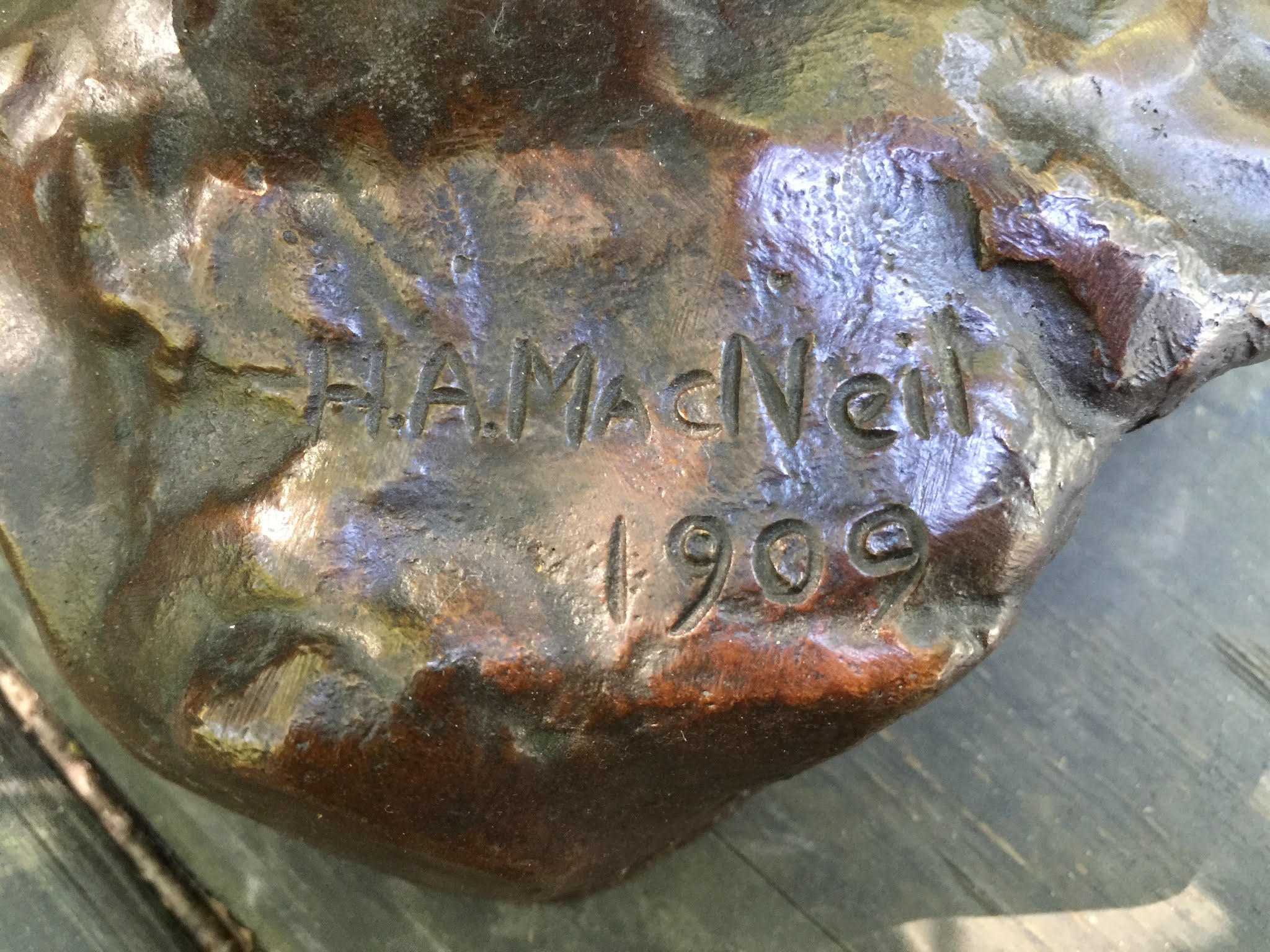
This casting, my copy, was made by Roman Bronze Works most likely in 1910 or 1911. It has an unusual 1909 copyright date on it, while most cast by RBW either show no date or are copyright 1901. Records from RBW indicate that two were cast in 1910 and one in 1911. It is my firm belief that MacNeil modeled the sculpture twice, first in Chicago and again in Rome. There are some small but pretty significant differences in the bronzes. Mine more closely resembles the earlier model but is more finely finished than "Primitive Indian Music." I'm still trying to put all of the bronzes into a timeline. It's difficult.

One other thing to keep in mind is that art bronzes were generally made to order back then and were bespoke, meaning if a client wanted a change made, a bit of extra cash on top usually got the job done. Foundry workers also were not above re-creating damaged details or adding new ones when preparing the waxes for molding. Now, Roman Bronze Works was also not above creating "spurious" or off-the-books castings (meaning they used the plaster model and/or molds but didn't tell or pay the artists) for their clients and contemporary reports mention that Winslow Brothers Co. cast only one in bronze, so the true number of lifetime castings may never be known. 

 None of the lifetime castings were either dated by the foundries nor were they numbered sequentially, though the castings from RBW that were numbered in a closed edition were, I believe, cast posthumously for MacNeil's second wife and son. Those bronzes are also marked "Cire Perdue Cast" so are easy to identify. I do not have a provenance for mine, the person who sold me this bronze had bought it fifteen years earlier from an online dealer, so I do not know who was the original purchaser or when it was purchased. The auction house that I suspect may have sold it in 1988 lost all of their records in a disastrous fire in 1990. Research is ongoing, but I may have hit a proverbial firewall. Most of the other lifetime (of H. A. MacNeil that is) castings of Primitive Chant are owned by museums, including the Metropolitan Museum of Art in New York City, the Gilcrease Museum in Tulsa (they have two!) and the Smithsonian in Washington, DC. No matter the provenance, I'm in rarified company!

Here we have a bronze statue of an athletic sixteen (or seventeen, his birth records are approximate) year old Lakota youth. The sculpture stands approximately 24.5" tall and has been deemed period authentic by a couple experts. He is wearing a loincloth with just a fringe of a front flap and no rear flap (some have a rear flap, but like the 1894 original, mine doesn't), low moccasins and two upright feathers in his hair (many of the bronzes have one feather curled over, mine is closer to the 1894 original). He is dancing sinuously with his right foot raised to his own music which he makes by blowing into the crook of his right elbow. The sculpting is fantastic, a beautiful example from a master sculptor of the Beaux Arts era. The bronze is in magnificent condition, especially considering its age. There are no dents or bent parts, only a couple light scratches in the patina commensurate with age. These will "heal" over time to an extent as the bronze further ages. I have cleaned and waxed him, removing the interstitial dirt and sealing the surface from the elements.

I present to you Hermon Atkins MacNeil's 1894 masterpiece, Primitive Chant to the Great Spirit. New pictures will follow after I put together a new backdrop, but for now, Black Pipe dances in my back yard, dappled in sunlight. Enjoy! I know I do.


                        Primitive Chant by H. A. MacNeil, ca. 1910, bronze, front


                        Primitive Chant by H. A. MacNeil, ca. 1910, bronze, 1/4 front


                        Primitive Chant by H. A. MacNeil, ca. 1910, bronze, right


                        Primitive Chant by H. A. MacNeil, ca. 1910, bronze, rear


                        Primitive Chant by H. A. MacNeil, ca. 1910, bronze, left

                    Primitive Chant by H. A. MacNeil, ca. 1910, bronze, title


                    Primitive Chant by H. A. MacNeil, ca. 1910, bronze, signature


                    Primitive Chant by H. A. MacNeil, ca. 1910, bronze, foundry chop


Sunday, September 9, 2018

Indian Head Plaque by Alois Sutter

Here yet again is a lovely piece that I watched cycle through relisting after relisting on the big online auction site. I finally found the admittedly modest amount of buy-it-now money to snatch it out from under the dozen or so others who had also been watching it. I'm very glad it found its long term home on my wall!

This piece is a fine cast bronze (I believe it's bronze anyway) plaque of a handsome young Indian man's face. No patina has ever been applied, what is there has been brought about by time. What makes this a bit more unique is that the plaque is oval and the face is raised in high relief, so that it stands out to about where his ears would be hidden behind his hair. In his long hair he wears two feathers and some sort of ribbon or roach holding them upright on the back of his head, the hair at his temples being caught up in ponytails that are wrapped toward the ends. A pair of large hoop earrings, a highly decorated shirt and a peace medal around his neck complete his outfit. Around the front edge is a border with raised edges and "Indian symbols" inside. Cast on the back is, "Casted by Al. Sutter, N28, 2851 Wallace St. Chicago ILL." There is a lug at the top with a ring through it for ease of hanging.
A search of the 1928/9 Chicago City Directory shows an Alois Sutter living at 2851 Wallace Street. Bingo! But that's about all of the info that I have been able to find on him. That address is a 2 unit home (it was back then as well) and looks to be a rental, so I have no idea how long he lived there or what he did for a living. If anyone out there has any info on either this lovely plaque or Alois Sutter, please let me know!

 Note: The blue spots on the left side of the forehead in the first picture are from a TV that was on in the background, and the small white spots are flecks of house paint that come off easily with a fingernail but are difficult to see with the naked eye. I'll take new pictures after I remove them!


Indian Head Plaque, bronze, Alois Sutter (cast), 1928, front

Indian Head Plaque, bronze, Alois Sutter (cast), 1928, left

Indian Head Plaque, bronze, Alois Sutter (cast), 1928, right

Indian Head Plaque, bronze, Alois Sutter (cast), 1928, top

Indian Head Plaque, bronze, Alois Sutter (cast), 1928, bottom
Indian Head Plaque, bronze, Alois Sutter (cast), 1928, back

Young Farmer and Girl With Jug Inkwell by Peter Tereszczuk (1875-1963)

While the main thrust of my bronze collecting blog has been Native American Indian in theme, I do also collect bronzes from other genres that I also find both interesting and pleasing. Especially if I get a good deal on them! This bronze I find to be aesthetically appealing, a beautiful Art Nouveau antique that I was extremely fortunate to find. I purchased it in an online auction which had a sparse description but decent pictures and a very low starting bid. The inkwell was a bit dirty but not excessively so. What is left of the original applied (hot) polychrome patina could be seen, superseded on the exposed surfaces by the naturally occurring patina that only age can bring. I could see that with a proper cleaning and waxing that it would really look amazing.

I placed my bid and watched the auction closely. Happily and rather surprisingly, no one bid against me! A handful of days later, I was carefully removing the lightly encrusted dust of many years and applying fresh wax. It really looks fantastic now! The deterioration of the coloration that the artist either applied or specified has been slowed if not halted, and the dirt that promotes corrosion has been removed and blocked from the surface of the bronze in the future. With routine care, this inkwell should easily last centuries if not millennia.

With a little research, I quickly found that I had purchased not just an old inkwell but a real treasure. Peter Paul Tereszczuk (his signature here is the earlier version that he used) was born in 1875 in Wybudow, a village now in the Ukraine but then a part of the Austro-Hungarian Empire. He moved to Vienna, Austria to study woodcarving at the school of Arts and Crafts in Vienna under Hermann Klotz. By 1895 he was an established and well known sculptor in Vienna. He mostly created small sculptures, often as decoration on tabletop objects ranging from lamps to desk sets (inkwells, blotters, card trays and the like) to vases and jardieneres, an incredible range of objects and sculptures over a roughly thirty year period. Tereszczuk created many of the fanciful and beautiful lamp bases that are topped with the incredibly beautiful glass shades of Loetz, Émile Gallé, Daum Nancy and many other top level French and Bohemian glass artisans of the day. He was one of the first (if not THE first) Art Nouveau sculptors to add carved ivory to his bronzes, replacing faces, torsos and other areas of bare skin in a revival of the style called "chryselephantine" that dates back to ancient times. Though these now-antique works can be tricky to import (if not own) due to laws designed to protect our endangered animal populations, they are highly collectible. His prolific works helped define Viennese Art Nouveau at the time and for the ages, but by 1925 Art Nouveau was being replaced by Art Deco. He briefly worked in this new style but rather quickly disappeared from the art scene. Peter Tereszczuk passed away in Vienna in 1963.

Depicted here is a couple sharing a drink from a jug. The young man is seated, he is shirtless but is wearing a pair of simple loose pants and the plain boots of a farmer. In his right hand is a large scythe, the blade resting on the ground below his dangling feet. On his head he is wearing a simple felt hat commonly known in antiquity as a pileus, which was the symbol in Roman times of a freed slave and is still a symbol of freedom today. His left hand is raised, holding up a jug which is also supported by a young woman who is laying across his lap. She is wearing a kerchief around her head, a simple blouse with the sleeves rolled up, a sash wrapped around her waist and a peasant style dress that fans out across her seat. She is also wearing low boots or shoes which peek out from under the hem of her dress. The pose of the pair is very naturalistic and highly detailed, the expressions on their faces exquisitely rendered. The young man's muscles are so well sculpted that even his veins can clearly be seen. To the right of the couple is the lid to the ink pot, also so well rendered that it takes a fairly close look to make out the edges of the opening. Inside is a soldered-in tapered insert which shows little sign of having held ink in the past, though  it may have had a glass insert that has gone missing. The base is designed as a tray, to lay pens on between uses. It too shows no ink stains that I could see. The bronze was originally carefully patinated, the skin, clothes and base carefully colored using a hot chemical process, not cold painted like the more mass produced Vienna bronzes most of us are familiar with. The colors have darkened over time. This piece, though utilitarian in nature, was created as fine art. Overall, this is an elegant piece of desk furniture, elevating the normal and everyday to high art.

This inkwell is signed P. Tereszczuk on the back and has a foundry mark, a K inside a horseshoe, for K. Korff (a sculptor whom I believe had his own foundry in Vienna). It's in perfect, undamaged and lightly used condition and has a lovely patina commensurate with age. It's most likely an earlier work as it is made of solid bronze. Once the artist began working with ivory, most of what he created had at least one ivory element in it.

I have only found a couple pictures of another inkwell like mine, though that one was rather unfortunately damaged, having a hole in the base behind a dangling foot. I have yet to find another. It's rare indeed!

I'm very happy that I have this lovely sculptural inkwell in my collection. It's a beautiful example of the work of an incredibly talented artist.


Young Farmer and Girl With Jug, Vienna bronze inkwell, Peter Tereszczuk, front, closed

Young Farmer and Girl With Jug, Vienna bronze inkwell, Peter Tereszczuk, front, open

Young Farmer and Girl With Jug, Vienna bronze inkwell, Peter Tereszczuk, left
Young Farmer and Girl With Jug, Vienna bronze inkwell, Peter Tereszczuk, right

Young Farmer and Girl With Jug, Vienna bronze inkwell, Peter Tereszczuk, back

Young Farmer and Girl With Jug, Vienna bronze inkwell, Peter Tereszczuk, signature