Search This Blog

Wednesday, May 1, 2013

Joe Beeler (1931-2006), Cowboy Artist Extraordinaire!

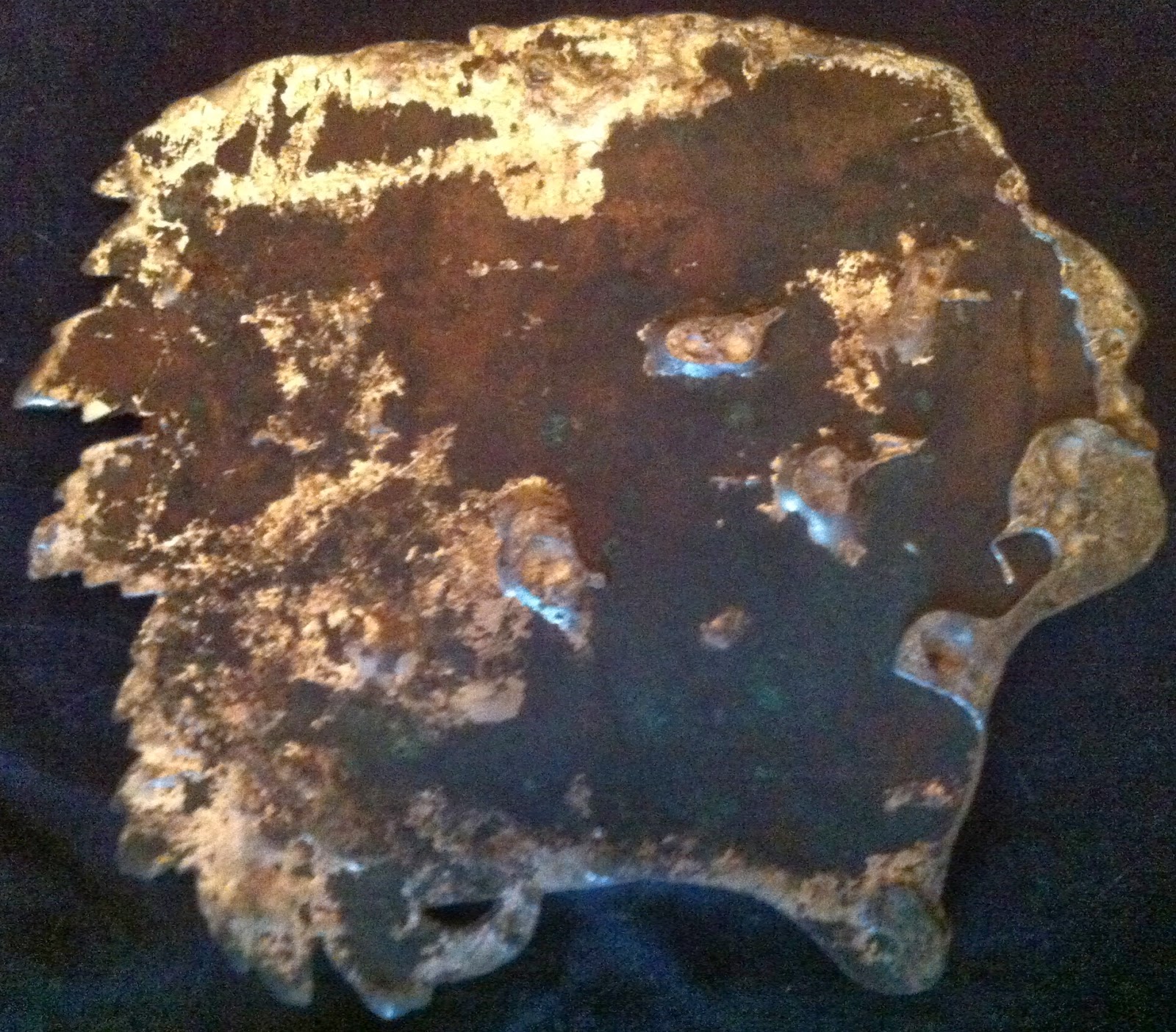
Another happy find for my collection was this bronze award plaque from the Arizona Historical Foundation. Now, you might not think that what is essentially a trophy could be considered art. I say, consider who sculpted it!

The Arizona Historical Foundation was founded in 1959 by Senator Barry Goldwater, who had no small measure of fame as a photographer himself. Members of the board came from among the politically powerful and "upper crust" of Arizona society. One of the prominent members of the board was grocery store magnate Eddie Basha. He was close friends with the well-known artist Joe Beeler (in fact, Mr. Basha had Mr. Beeler design many "tokens" that Eddie used to give out as gifts - they are highly collectible now!). While this piece is unsigned, it's not surprising that when they wanted a showy award, these bigwigs went to the local bigwig artist to have it made. The plaque depicts the residents of Arizona through history - the Indian, the Spanish Priest and the Cowboy, along with a few Arizonan implements (like a gold pan and cattle brand), on a background of Arizona's sun rays (from the state flag). The Arizona Historical Foundation was merged into the Arizona Historical Society in 2012, so these awards will never be given out again.

I don't think I really need to write a whole lot about Joe Beeler. He was a famous artist in his lifetime, and is still highly regarded today. His bio can be found all over the web.

Mine is an early award - on the canteen is inscribed "US ARMY" (rather awkwardly, actually). On later casts this area was smooth. I'm uncertain how many were made or awarded. The research is ongoing.

Edit: I recently found this in the Arizona State University (ASU) General Catalogue of 1965-67; "Arizona Historical Foundation Award. A cash award of $100 and a bronze plaque emblematic of the joint contribution of the Indian, Spanish, Mexican and Anglo-American cultures of Arizona, given to a graduating senior in history who has shown outstanding aptitude in Arizona and Southwestern history." The award is still mentioned in the ASU GC of 1968-1971 but no mention is made of the specifics of the award, only that it was awarded to a senior. No mention of the award is found in the GC's prior to the 1965-67 edition or in the 1979-81 and after, so without anything else to go by,  I must assume that this plaque was not awarded more than a dozen or so times at ASU (between 1965-1978) and possibly less, if the later awards were just cash. The plaque may have been given out with other AHS awards however... but if it was limited to just one ASU senior per annum for 13 years more or less, then it's a rare piece indeed!

"Arizona Historical Foundation Award" by Joe Beeler, front

"Arizona Historical Foundation Award" by Joe Beeler, back

"Arizona Historical Foundation Award" by Joe Beeler, detail


Joseph De Yong, assistant to Charles Marion Russell and friend to the stars

Next up is a piece by yet another overlooked artist (undeservedly overlooked, in my opinion). Joseph Franklin De Yong (also spelled DeYong, deYong and de Yong, 1894-1975) was born in Missouri but raised in Indian Territory (known as Oklahoma today). He was a childhood friend of Will Rogers and poked cattle as a teenager with Tom Mix, most likely on the Miller Brothers 101 Ranch outside of Ponca City, Oklahoma (they ran a Wild West show, much like Buffalo Bill's). A bout of spinal meningitis at 18 left him profoundly deaf and weak on one side of his body, though the weakness eventually passed. During his recuperation, he wrote letters to his favorite artist, Charles Marion Russell, whose works he had seen in magazines. Russell hired on the talented young artist as his assistant in 1916, a position De Yong held until Russell's death in 1926 (they were both fluent in Indian sign language - the studio was said to be a quiet place!). He went on to become a successful technical consultant and set designer for Western movies made by such friends as John Wayne and Cecil B. DeMille, though he never married or had children.

Joe De Yong's works have, until recently, fallen into the Zelig-like space of "also ran". He was there at all the important events and knew everyone of consequence, but was not himself famous. It's a position that he did not deserve. I think that had he pushed his own work more than spending his life after 1926 safeguarding Russell's legacy, his work would be better known to the world at large. Fortunately for us all, Joe De Yong's fame is only growing every year.

This piece is something of a conundrum for me. Titled "Piegan Indian Head", the original casting was done most likely in the 1920's or 30's, in a run of 35. My bronze is not numbered, not signed and actually has greater detail (especially in the robe and hair) than the original casts! I'm somewhat befuddled by it. I have never heard of anyone (in their right mind or not) making knockoffs of Joe De Yong's bronzes. He just wasn't that popular. Yet this one is clearly newer than the original casts, but still has some real age to it.  My guess is, toward the end of his life, Joe had new casts made from his original model, probably using the lost wax method. Now, if the originals were sand cast, that could easily explain the difference in the level of detail between the two. Unfortunately, most of the people who could have cleared up the mystery have passed on. If anyone out there knows the real story, please let me know!

P.S. - The white you see on the piece is what happens when you're distracted in the middle of waxing a bronze and don't get back to polish it for a week. 

P.P.S - I have recently purchased another copy of this piece, this one signed by the artist. I am looking forward to comparing the two when it arrives. Stay tuned!

"Piegan Indian Head" by Joe De Yong, bronze, front

"Piegan Indian Head" by Joe De Yong, bronze, left

"Piegan Indian Head" by Joe De Yong, bronze, back

"Piegan Indian Head" by Joe De Yong, bronze, right


Gary Herbert (1935-2006) "Navajo Man II"

Here is a lovely bronze by listed Colorado artist Gary Herbert. The artist led an interesting life - he was a lawyer who drew cartoons for Harvard Lampoon while in law school. While practicing law, he was inspired by a colleague's collection of Frederic Remington bronzes to begin sculpting. He quickly gained a reputation for his work and was soon giving up law to sculpt full time. He only sculpted from live models, never from photographs. After a devastating car accident in 1980, he returned to law practice but continued to sculpt in his free time. He passed away in 2006 at 71.

This is another piece that I'm very lucky to own. In my opinion, artists like Gary Herbert are under-appreciated in today's market. His pieces are very well done, but his name is relatively unknown. I really think that some day, his work will be just as collectible as those by Phimister Proctor or Bessie Vonnoh Potter. "Navajo Man II" is number 5 of 15 and was created in 1973.

"Navajo Man II" by Gary Herbert, 1973, 5/15, front

"Navajo Man II" by Gary Herbert, 1973, 5/15, left

"Navajo Man II" by Gary Herbert, 1973, 5/15, back

"Navajo Man II" by Gary Herbert, 1973, 5/15, signature

An Unknown Commemorative Plaque

I bought this a couple years ago in an online auction for really very little. It's clearly a commemorative plaque of some sort, but is totally unsigned and unidentified. The level of detail is amazing! The bronze depicts a group of people barricaded in a cave while the Indians attack, coming over a pile of sticks and pushing past a cloth that blocked the entrance, with long knives and hatchet held high. A man stands on the right, wearing the outfit of a Colonial era soldier, pistol in hand. At his feet a woman gives comfort to another young lady. Both wear dresses also correct for the Colonial era. At the lower left, another man with long hair, also wearing period clothes including a long coat with wide cuffs, reclines on the ground. In his right hand is what appears to be a book. It also looks like his pants are partway down! Next to his right hand is a pile of military-related items - the hilt of a broken sword, some sort of trumpet-ended object (musketoon barrel?) and possibly a cloak. The Indians have their heads shaved save for scalp locks that are tied up in roaches, much in the manner of Northeastern Woodland tribes of the day (especially Mohawk and Iroquois) and appear to be shirtless.

For the life of me, I haven't been able to find anything about the scene depicted. I've beat my head against this wall enough, so now I'm putting it out in the world and hoping for an answer. The seller said she picked it up at a yard sale somewhere in New England... I'd dearly love to know what exactly is being depicted here, even if it only shows one rather specific viewpoint. Four European colonists in a cave, a younger-looking man with long loose locks laying on the ground apparently with his pantaloons halfway down, a younger-looking woman in distress being cradled by an older woman, both across the cave and also on the ground, being guarded by an older soldier while the Native raiders attack. Really?! Just what is going on here?

I have found that this plaque is merely the center panel of a larger bronze plaque or charger. I have purchased two of these as well and will post pictures soon. It is made of cast bronze but is not overly large or heavy and may well have been meant to be used as a charger under a glass dish, if not a wall hanging. I have yet to find a signature on that, either, though I have seen a few other identical ones for sale too.

Edit: I think this scene depicts Chapter 12 of James Fenimore Cooper's "Last of the Mohicans," the defense at Glens Falls. Major Heyward (in uniform) stands at the ready, Cora and Alice huddle to the right and David Gamut the music master sprawls on the floor while the Huron break through the defense. It fits entirely with a late 18th century dating (seems accurate given the patina of all of the pieces) and probably a French origin, as Cooper lived in Paris for years and his novel was a solid hit in France at the time.

Unknown Commemorative Bronze Plaque, front

Unknown Commemorative Bronze Plaque, back


Saturday, April 20, 2013

A Mystery Bronze!

I own several antique bronzes that are mysterious in origin, being unsigned artworks, unmarked advertising pieces, awards, or decorations from an old bank building or some such. I think this one is either an advertising piece or was a logo on some antique thing or another.

I've seen LOTS of reproductions of this image, often as part of a round plaque or medallion. I've also seen them like mine, trimmed around the image, however I've only seen one or two others that have any sort of marks stamped into them, or have details as crisp as this one. On the neck, mine has stamped "REG. U.S. PAT. OFF." There is a fair amount of solder on the back, so I can assume it was once affixed to some other piece of metal as a company logo, though which company that was, I don't know. I haven't cleaned the grime off of it yet, nor given it a good waxing, so I haven't found any other signatures or marks yet. This piece, like the Bergmann Indian with canoe in my last post, came from a hoarder in NY. Supposedly this one sat in a workbench drawer for over fifty years.

If anyone knows the history of this image, please let me know!

Antique Bronze Indian Head Logo, front

Antique Bronze Indian Head Logo, back


"Indian Scout With Canoe" Franz Bergmann Vienna Bronze, Probably By Carl Kauba - Antique!

This is one of my most recent purchases. It's a bronze Indian Scout and Canoe by the Franz Bergmann (often mistakenly spelled "Bergman") foundry in Vienna, Austria. It is about a hundred years old! These Vienna bronzes are pretty rare. They came in so many varieties that not many of any one style were made. I've seen the canoe used in at least three different bronzes, and the Indian (usually holding a rifle, pipe, spear or tomahawk instead of a paddle) in at least four or five more. These bronzes were made from many different models which were individually cast and soldered together in a different way for each specific run of sculptures. I've only ever seen three others of this particular one, however, and one was cast from white metal instead of bronze. I believe the Indian may have been sculpted by the famous Carl Kauba, as I've seen his name inscribed on this very Indian when it was a part of a different sculpture.

My statue was once cold-painted in vivid colors, just like the typical Vienna bronzes are still made, but it appears that some time in antiquity someone decided that it would look better gilded. That gold paint has mostly worn off by this point, leaving the original paint peeking through, as well as a few spots of bronze. I was told this came out of a hoarder's house in New York, and that it had sat high on a bookshelf for over half a century. At some point this bronze had a fall - the Indian's left leg and paddle are bent, as is the upper edge of the canoe where they are brazed together.

Both the Indian and the canoe are signed with the Bergmann "B" inside a shield and the number 3605 (the model, pattern and/or catalog number of the sculpture). The Indian has "GESCHUTZT" (German for "protected", shorthand for copyrighted) stamped down the side of his left buttock and the Bergmann foundry mark and 3605 on the back of his left leg just below his buttock. Where I have seen the Kauba signature on the back of the leg of identical Indians that are part of different overall scenes is where this one is soldered to the canoe. The canoe has the foundry mark and pattern number on both sides of the underside, just above the seam.

The last few pictures were taken through my Luxo magnifier. The fluorescent light tends to throw the color balance off, but I really wanted good close ups of the hallmarks.

I may have it repaired in the near future. The damage isn't severe, and I think it would be well worth the expense to have it fixed correctly. I don't have much into it...

I have recently purchased a white metal copy of this bronze. It does not have hallmarks or signatures but it was probably also produced by the Bergmann foundry. It is in near pristine condition, even the paint is nearly perfect. I'll post pictures of it soon.

"Indian With Canoe", Franz Bergmann Foundry, Vienna, front

"Indian With Canoe", Franz Bergmann Foundry, Vienna, close up

"Indian With Canoe", Franz Bergmann Foundry, Vienna, back

"Indian With Canoe", Franz Bergmann Foundry, Vienna, canoe hallmarks


"Indian With Canoe", Franz Bergmann Foundry, Vienna, Indian hallmarks

"Indian With Canoe", Franz Bergmann Foundry, Vienna, "GESCHUTZT" hallmark on Indian

"Indian With Canoe", Franz Bergmann Foundry, Vienna, Bergmann foundry hallmark on Indian

Terry S. Gilbreth Bronze - A Very Lucky Find

Another piece that claims a place of pride in my collection is this bronze by Texas artist Terry S. Gilbreth titled "Seeking Ancients". This is numbered 1 (yes, the very first!) of 25. That means that in the entire world, there are only 25 of these, and I have the first. It's kind of mind-blowing.

You really have to see his work to believe it. I still can't believe I was fortunate enough to find this, much less be able to afford it. I really can't believe I wasn't outbid, either! The universe aligned for me, I figure.


"Seeking Ancients" by Terry S. Gilbreth, bronze, 1/25, front

"Seeking Ancients" by Terry S. Gilbreth, bronze, 1/25, right

"Seeking Ancients" by Terry S. Gilbreth, bronze, 1/25, back

"Seeking Ancients" by Terry S. Gilbreth, bronze, 1/25, left
"Seeking Ancients" by Terry S. Gilbreth, bronze, 1/25, signature

A Beautiful Bronze By Nelson Tsosie, Diné Artist

This bronze was an extremely lucky find, with a very low buy-it-now price that I could actually afford. I snapped it up! The piece is titled "Mighty Hunter" by Arizona artist Nelson Tsosie (tribal affiliation: Navajo). It depicts an Indian boy sighting in his arrow while laying among the rocks. It's a very well executed and cute work! The colorful patinas add to the "wow" effect and really make it pop. The concentration on the boy's face is captured so well... This one is numbered 17 of 25 and is in perfect condition. I couldn't get a clear picture of the signature, sorry about that.

Check out Mr. Tsosie's work - the link to his site is at the right. He's really good!


"Mighty Hunter" by Nelson Tsosie, bronze, 17/25, front
"Mighty Hunter" by Nelson Tsosie, bronze, 17/25, left

"Mighty Hunter" by Nelson Tsosie, bronze, 17/25, back

"Mighty Hunter" by Nelson Tsosie, bronze, 17/25, right


My Charles Marion Russell bronzes

Much as my first post may have seemed like a rant against knockoffs and ripoffs, there is one fact that overrides my objections. I'm po. Like, open the wallet and moths come out - level po. Heck, I can't even afford to put the "or" on the back end of "po". Two letters? Too much!!!

For me, it's all a matter of what kind of deal I'm getting on the pieces offered. If I can find an original, or one from an original run of a bronze and I can afford it, then sure! That's what I'm going to buy. But if I find a decent reproduction for a silly low price, then why not? That's where my Charles Marion Russell pieces come in.

I've always been a huge fan of Russell, more so even than of his contemporary and friend, Frederic Remington. In my opinion, ol' Charlie had a crackin' sense of humor, and it comes through most clearly in his sculptures. To me, they have a playfulness, a joie de vivre, that is really lacking in most Western art. Most artists seem to have a serious point to make with their art - even the way they capture play makes a serious statement. Charlie's work, on the other hand, is imbued with that playfulness instead of merely illustrating it. If I were at a gallery opening of his one-man show, I picture him with a tumbler of whiskey in his hand, poking me in the side and sharing a smile and chuckle over one of his sculptures. It's like being in on the joke.

The first one here is titled "Scalp Dancer". It is signed with Russell's name and buffalo skull mark, but there are no foundry chop marks or catalogue numbers (most of his original bronzes were not limited by edition size, but by how many he could sell). I believe it was made sometime in the 1980's, but I'm not sure. It's in great shape, with no visible or known flaws, and is quite substantial and heavy. I bought it for peanuts (I ate crackers that night, having spent the peanuts), considering the actual going rate for a reproduction like this is well in the order of ten times more.  As a bonus, the seller was in my home town, and it was an easy drive to pick it up (and I saved on shipping). Score!


"Scalp Dancer" by Charles Marion Russell, posthumous copy, front

"Scalp Dancer" by Charles Marion Russell, posthumous copy, right

"Scalp Dancer" by Charles Marion Russell, posthumous copy, back


"Scalp Dancer" by Charles Marion Russell, posthumous copy, left

"Scalp Dancer" by Charles Marion Russell, posthumous copy, signature


The second piece is titled "Buffalo Rubbing Rock" and was one of a pair intended as bookends. The seller only had one, and who needs half of a pair? Well, as a matter of fact, I don't mind that at all. I figure this is a third or fourth generation recast made somewhere around the 1950's-60's. The detail is nowhere near as sharp as it should be, but the patina and marble suggest the date. Again, it was cheap - really cheap. I think the scrap value of the bronze is actually higher. Like "Scalp Dancer", this is signed CM Russell, dated 1921 and bears his buffalo skull device, but no foundry marks. An almost identical one sold at Bonham's very recently (last week) for $625. SCORE!!

"Buffalo Rubbing Rock" by Charles Marion Russell, 1921, bronze, posthumous recast, front

"Buffalo Rubbing Rock" by Charles Marion Russell, 1921, bronze, posthumous recast, right

"Buffalo Rubbing Rock" by Charles Marion Russell, 1921, bronze, posthumous recast, back

"Buffalo Rubbing Rock" by Charles Marion Russell, 1921, bronze, posthumous recast, left
"Buffalo Rubbing Rock" by Charles Marion Russell, 1921, bronze, posthumous recast, signature


Gordon G. Pond (1920-2001) - "Mescalero Apache"

This bronze is something of a mystery to me. I purchased it from a dealer who specializes in Western decorative pieces, yet it's definitely a fine art lost wax casting. The artist, Gordon G. Pond (1920-2001), was a professor of art at Compton College in Los Angeles. He used to spend his summers in Arizona, where he painted the local landscape, towns and people. He was also an amateur archaeologist, writing several articles for magazines and two textbooks over the course of his life. Mr. Pond retired to Arizona where he continued to create art until his death in 2001. Now, I've seen many of his paintings, and they're quite nice, if a bit stylized. I had never encountered a sculpture by him before, however. This undated bronze is titled "Mescalero Apache" and is signed Gordon G. Pond. There are no foundry or edition marks on it that I could find. I had thought it unique, but recently I had an email from a fellow who says that his father bought a copy many years ago from a gallery in Arizona.

If anyone has more info on this lovely piece, please let me know!! And yes, he does lean a bit to one side, and no, he's not damaged - he's leaning on his spear.

"Mescalero Apache" by Gordon G. Pond, bronze, front

"Mescalero Apache" by Gordon G. Pond, bronze, left

"Mescalero Apache" by Gordon G. Pond, bronze, back

"Mescalero Apache" by Gordon G. Pond, bronze, right

"Mescalero Apache" by Gordon G. Pond, bronze, signature

A Piece By Sculptor Alex LaFountain

Next up is a piece I won in an online auction by the late Chippewa artist Alex LaFountain. He was primarily known as a sculptor, but was an accomplished painter as well. He owned his own foundry, and from about 1970 cast his own bronzes.

His was a rather tragic death - in August of 1971 he was riding an air mattress down the Missouri River near Great Falls, Montana, not far from his hometown of Lewistown. He spotted a swimmer in distress and jumped in to save him, and drowned in the process. He was highly regarded in his lifetime, and is still widely collected today. I'm very fortunate to be the owner of this fine and fun piece.

I believe the title is "Dancing Bear," but I'm not certain. Mine is number 4 of 40, made in 1969. It's a very playful piece, and very popular with young 'uns as well as the young at heart.

"Dancing Bear" by Alex LaFountain, bronze, 1969, 4/40, front

"Dancing Bear" by Alex LaFountain, bronze, 1969, 4/40, right

"Dancing Bear" by Alex LaFountain, bronze, 1969, 4/40, back

"Dancing Bear" by Alex LaFountain, bronze, 1969, 4/40, right
"Dancing Bear" by Alex LaFountain, bronze, 1969, 4/40, signature